X-ray Absorption Spectroscopy (XAS) of Fe and S Species
I started my postdoctoral work at the University of Saskatchewan by analyzing previously collected data from the SXRMB beamline at the Canadian Light Source (CLS). The data included standards and real samples with both Fe and S K-edge XAS measurements. Using Linear Combination Fitting (LCF), one can determine what standards constitute the measured samples. Fe K-edge XAS has an interesting pre-edge feature that gives a lot of information on the coordination environment of Fe atoms.
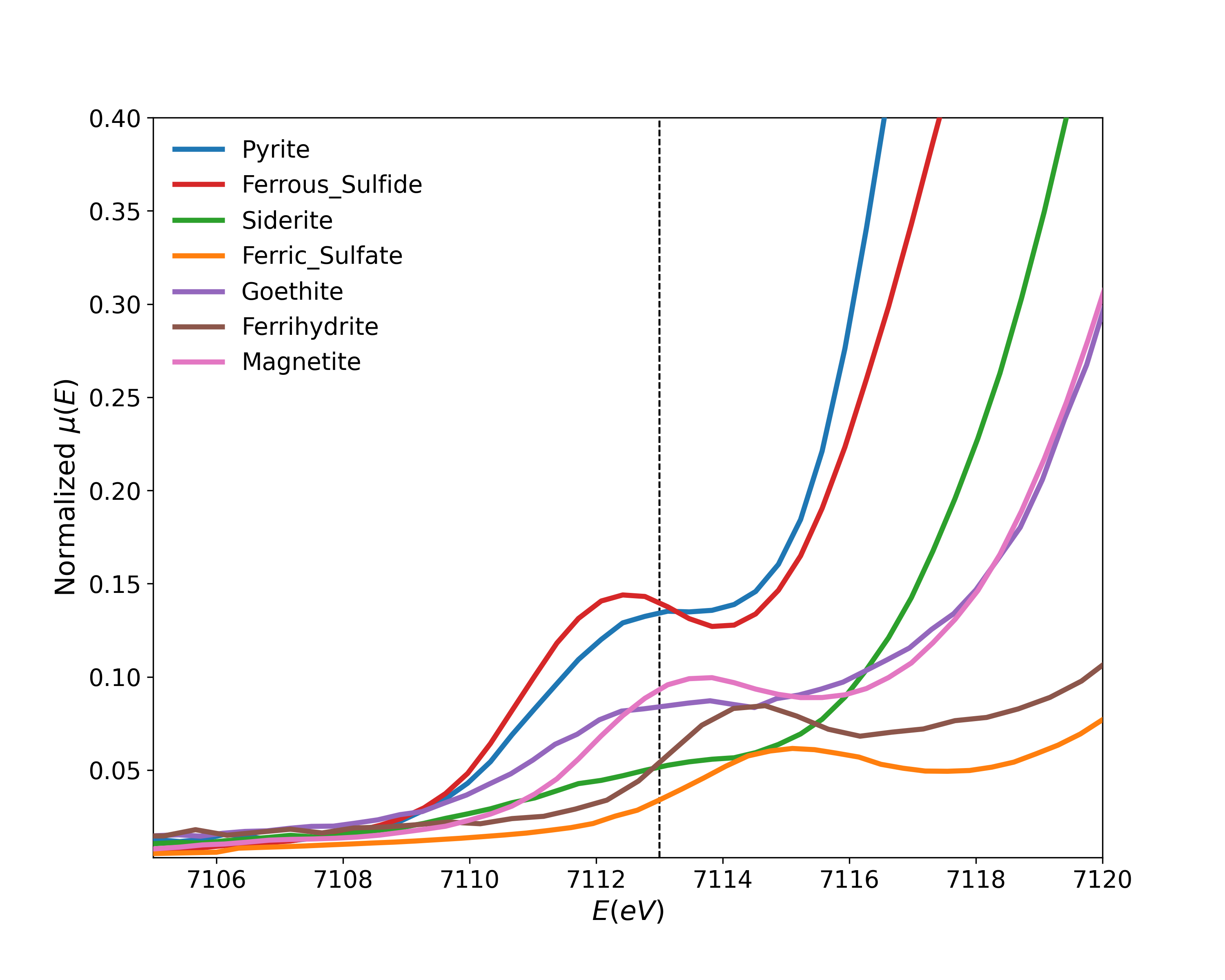
Fitting this pre-edge feature allows determining the Fe(II)/Fe(III) ratio:
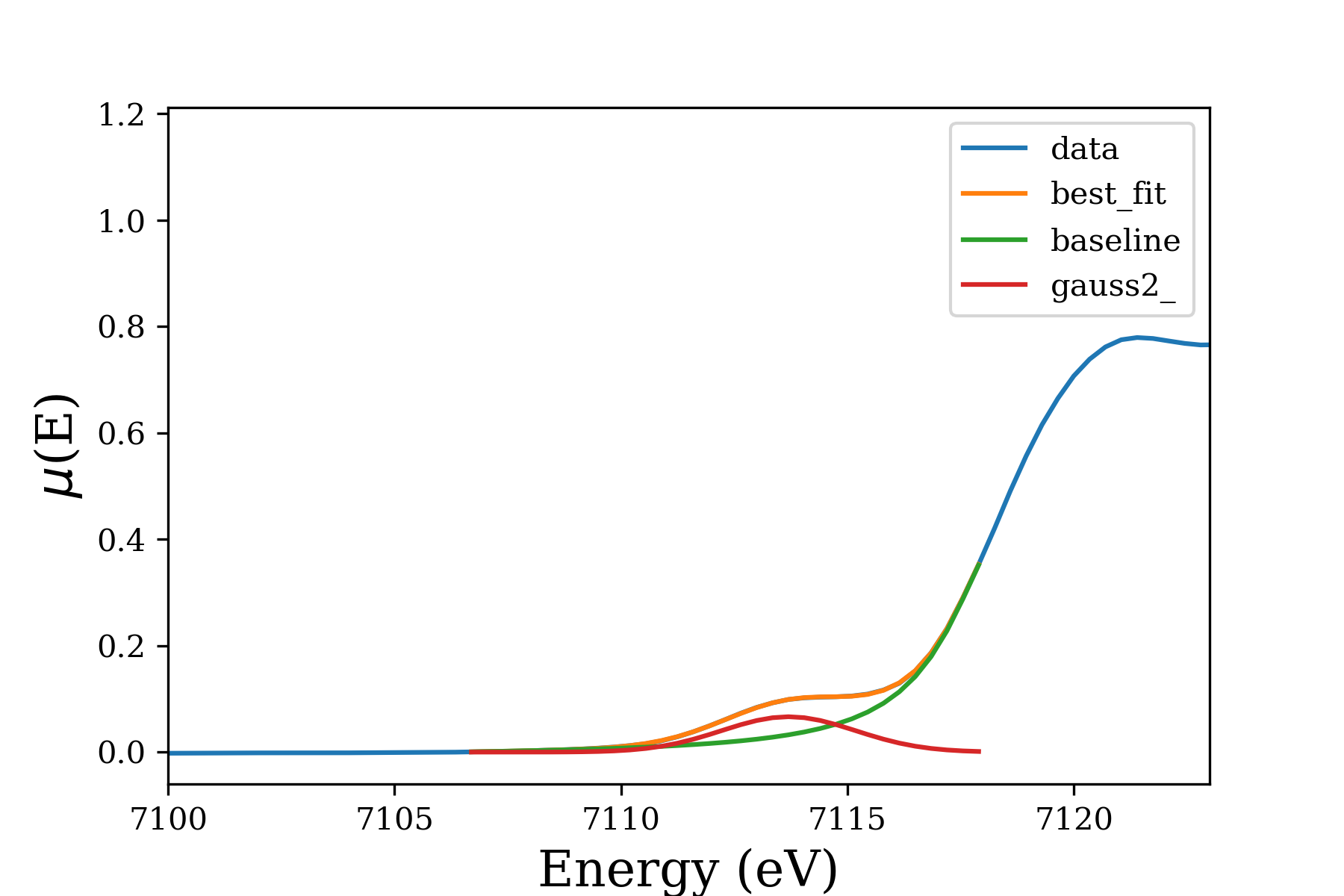
The pre-edge feature is due to the \(1s \rightarrow 3d\) transition, and is sensitive to the local environment (e.g. oxidation state, symmetry) of Fe atoms. The pre-edge centroid position depends mainly on the oxidation state of iron, while its intensity is mostly dependent on the coordination environment around Fe atoms.[1,2]
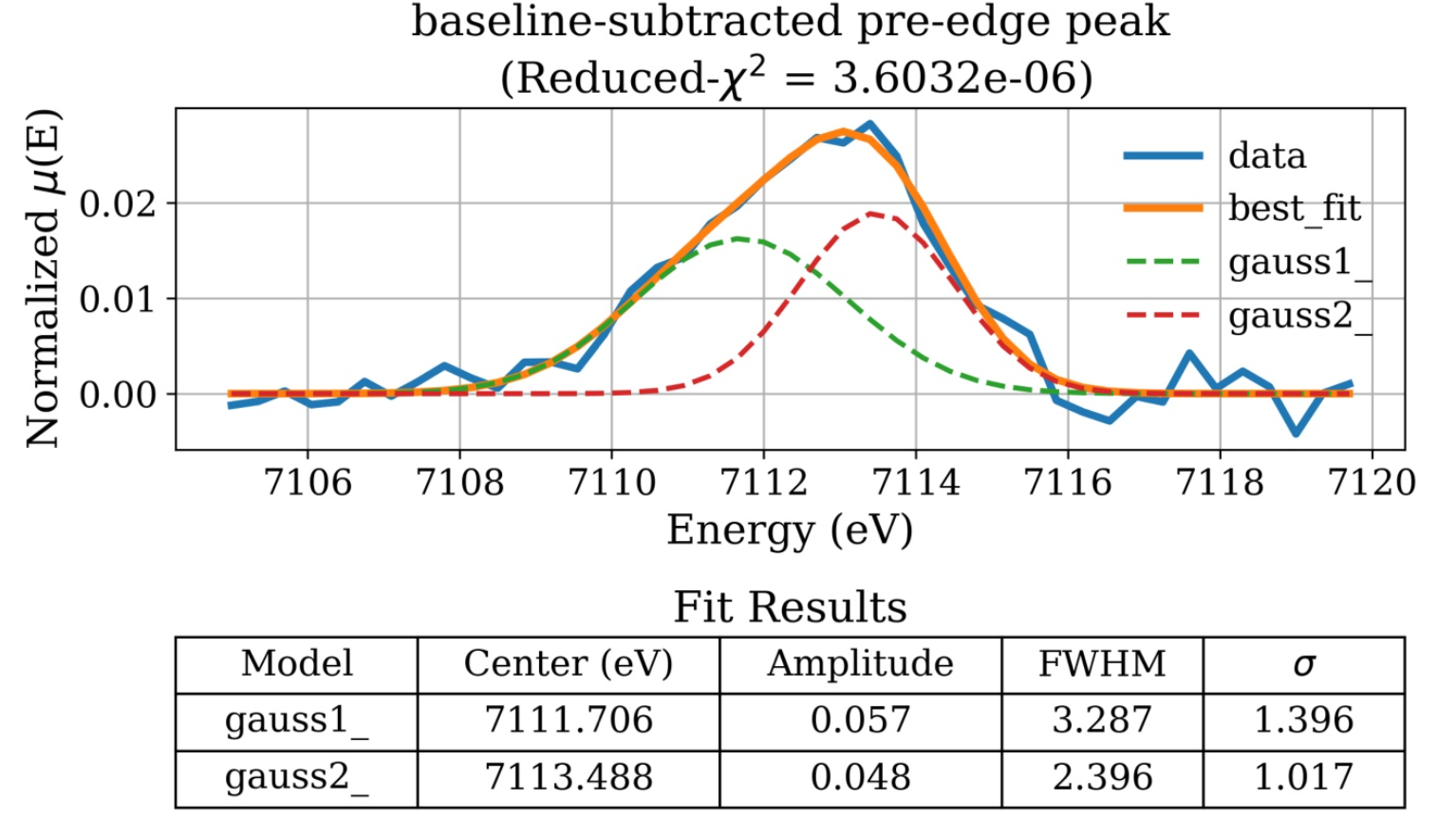
The pre-edge is extracted from XANES spectra using linear and Lorentzian functions to subtract the baseline in the range of 7100–7120 eV. The isolated feature is fitted with Gaussian components, with additional components justified by improvements in reduced-χ². The fit results include Amplitude, representing the area of the unit-normalized peak.[3]
The Fe²⁺/ΣFe and Fe³⁺/ΣFe Ratios: Individual pre-edge peaks between 7111.2–7112.2 eV are mainly due to Fe²⁺, and peaks in the range 7113–7114 eV are mainly for Fe³⁺.[4,5] The fit centroid is area-weighted:
\[ C = \frac{I^{\mathrm{Fe^{3+}}} E_0^{\mathrm{Fe^{3+}}} + I^{\mathrm{Fe^{2+}}} E_0^{\mathrm{Fe^{2+}}}}{I^{\mathrm{Fe^{3+}}} + I^{\mathrm{Fe^{2+}}}} \]
The centroid-based calibration reported by Knipping et al. is used to calculate the Fe²⁺/ΣFe ratios (valid when 7111.9 < C < 7113.4 eV; samples with a centroid above the upper range are considered 100% Fe³⁺):
\[ \frac{\mathrm{Fe^{2+}}}{\Sigma \mathrm{Fe}} = 1 - 0.5879 \times (C - 7111.9)^{1.2527} \]
References
- Yamamoto, T., et al. (2008)
- Wilke, M., et al. (2004)
- Newville, M. (2013)
- Knipping, J.L., et al. (2015)
- Alderman, O.L.G., et al. (2017)
- Wilke, M., et al. (2005)